These are our own numbers
Everything below was pulled from the Meta Marketing API on 3 September 2026, for the dataset behind dealoracle.io. It is one pixel on one funnel, not an industry benchmark. We are publishing it because almost nobody shows you what the score looks like on a properly configured setup.
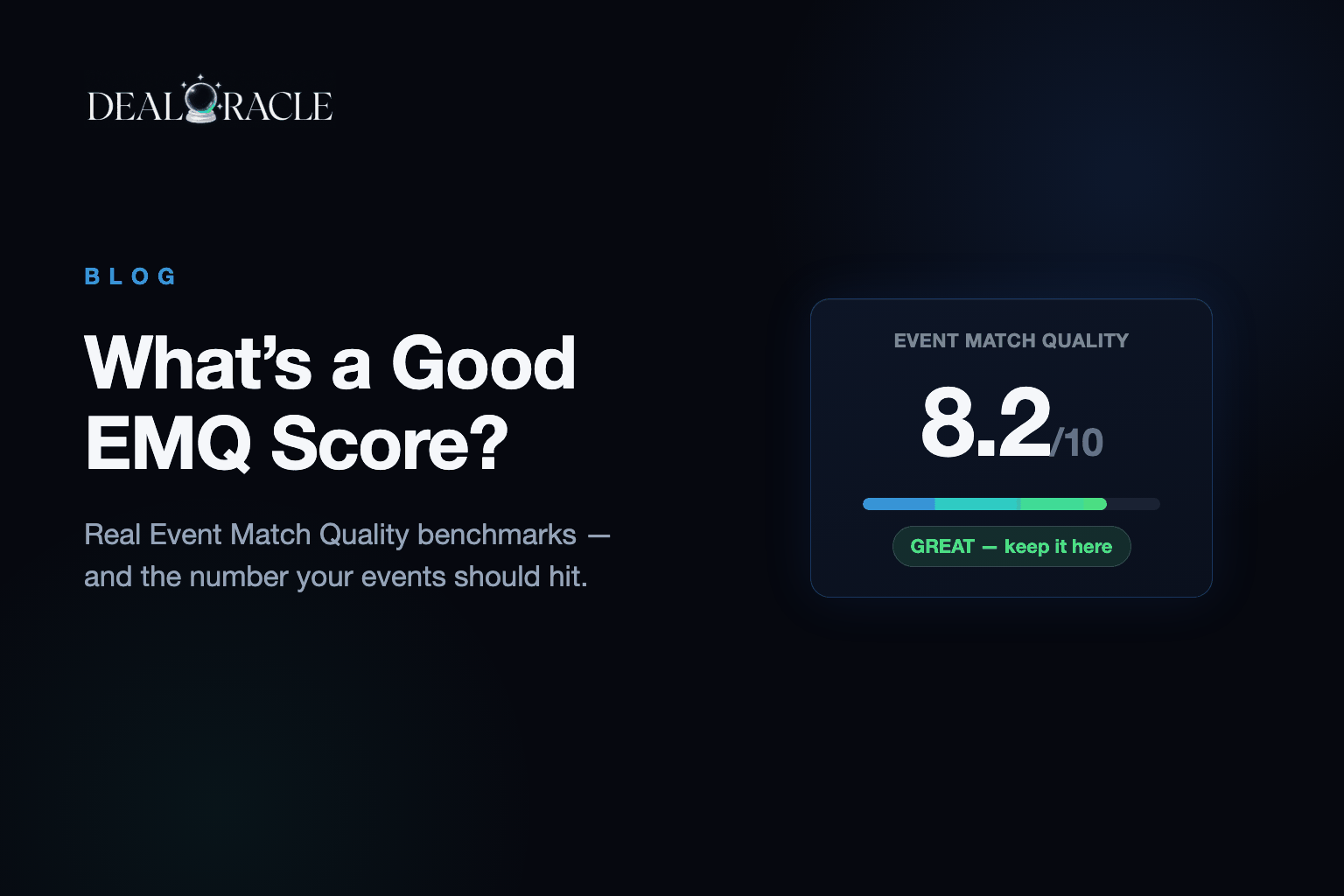
Event Match Quality is Meta''s estimate, from 0 to 10, of how confidently it can tie the conversions you report back to real people on its platform. It is the difference between telling Meta "someone booked a call" and telling it exactly who.
Most advertisers find the number in Events Manager, see a 5 or a 6, and have no idea whether that is normal, good, or quietly costing them money. So here is a real pixel, event by event.
| Event | Match Quality | What it is |
|---|---|---|
| Schedule | 9.3 | A booked call — full identity from the booking form |
| Lead | 8.3 | A form submission, enriched server-side |
| PageView | 8.1 | Ordinary traffic, identified where the visitor is known |
| ViewContent | 6.8 | Anonymous browsing — mostly cookies and network data |
| CompleteRegistration | 5.7 | Signup with name and email, but nothing else |
The spread is the interesting part
The same pixel, on the same site, in the same week, scores a 9.3 on one event and a 5.7 on another. Nothing about the pixel changed between them. What changed is how much was known about the person at the moment the event fired.
Look at the bottom of that table first. CompleteRegistration scores 5.7 despite having email, first name, last name, IP address, user agent and country at 100% coverage. Six identifiers, all present, every time — and it still scores below six.
Now the top. Here is every match key on the Schedule event.
| Match key | Coverage |
|---|---|
| 100% | |
| Phone | 100% |
| First name | 100% |
| Last name | 100% |
| City / state / postal code / country | 100% |
| External ID (stable visitor identifier) | 100% |
| Click ID (fbc) | 100% |
| IP address and user agent | 100% |
| Browser ID (fbp) | 50% |
Two keys explain almost the whole gap between 9.3 and 5.7: phone number and click ID, backed by a stable external ID.
Phone is one of the strongest identifiers Meta holds, because phone numbers are near-unique and rarely change. The click ID ties the conversion to the specific ad click that produced it, which removes the guesswork from attribution entirely. Neither one is present on a typical browser-only signup event — the pixel simply never sees them.
Note also that the browser ID sits at 50% on the highest-scoring event and it barely matters. Coverage on one weak key is worth far less than the presence of a strong one. Chasing 100% across the board is the wrong goal; getting phone, click ID and a stable identifier onto your important events is the right one.
Why a browser pixel alone tops out
A pixel running in someone''s browser can only report what that browser knows, after ad blockers, tracking prevention and cookie limits have taken their cut. It usually has a browser ID, sometimes a click ID, and whatever the person typed into the form on that page.
It does not have the phone number sitting in your CRM, the address captured at a later step, or the fact that this lead closed six weeks later for a five-figure deal.
Sending conversions server-side changes what is available. The event is assembled from everything you actually know about the person — hashed before it leaves, as Meta requires — rather than everything that happened to survive in the browser. That is the entire mechanism behind the scores above.
The second half of it is value. A conversion sent with the real deal amount attached tells Meta which leads were worth having. Optimising toward "filled in a form" and optimising toward "was worth £40,000" produce very different audiences.
How to check your own score
- Open Events Manager, choose your dataset, and open the Overview tab.
- Select an event that matters — Lead or Schedule, not PageView.
- Read the Event Match Quality score, then expand it to see per-key coverage.
That coverage breakdown is the useful part. It tells you exactly which identifier is missing rather than leaving you to guess at a single number.
If you are sitting at a 6 or 7 on your main conversion event, the missing pieces are usually phone number, click ID, and a stable identifier that survives across pages and sessions — precisely the things a server-side connection can supply and a browser pixel cannot.
Meta''s own guidance is consistent on the direction: advertisers who add the Conversions API alongside their pixel see better attribution and lower cost per result than the pixel alone. How much you gain depends entirely on how much signal you are losing today, which is why the coverage breakdown is worth more to you than anyone else''s average.
Related reading
For the field-by-field version of this — exactly which parameters to add and in what order — see our guide to improving your Facebook Event Match Quality score to 8 or higher.