Key Takeaways
- Most "ROAS drops" that panic advertisers are **measurement gaps, not real losses**, broken tracking looks exactly like a performance collapse. - **Confirm the drop is real first.** Look at a 7-14 day rolling average and statistical significance, not one bad day. - **Always rule out tracking before touching creative or bids.** Check that the Pixel + CAPI are firing, Event Match Quality is 6+, and deduplication is working. - iOS 17/18 and browser ITP broke pixel firing on a meaningful share of sessions; Meta's **Andromeda** signal re-evaluation (Q4 2025 to Q1 2026) quietly lowered scores on many accounts with no advertiser change. - If tracking is clean, a sudden drop in **weeks 6-12** of a stable campaign is almost always **creative fatigue**, ship 15-30 fresh variants a month, not the same 3-5.
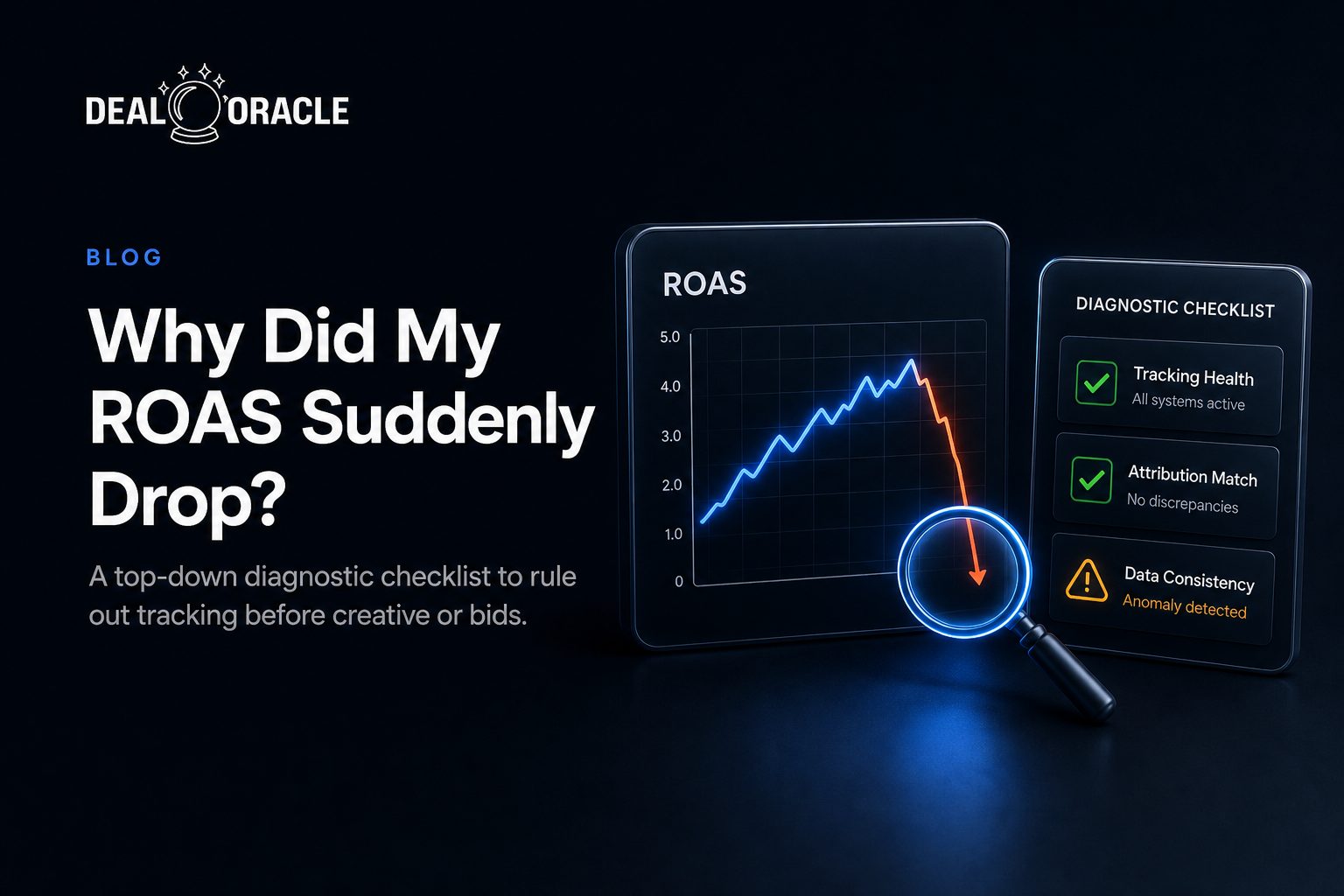
Your ROAS was 4.2 last week. This morning it's 2.6. Before you pause campaigns, slash budgets, or fire off an angry Slack message, stop. The single most expensive mistake in paid media is reacting to a number that isn't real, or fixing the wrong layer of the funnel.
The Problem
A sudden ROAS drop triggers a panic response: advertisers kill their best ad sets, rewrite creative that was working fine, or yank budget out of campaigns that were actually still profitable. The reported number went down, so something must be broken in the campaign, right?
Usually, no. The most common cause of a sudden, scary ROAS drop is not that your ads stopped converting. It's that your tracking stopped reporting the conversions that are still happening. A broken pixel, a degraded server-side feed, or a platform-side signal re-evaluation produces a chart that looks identical to a performance cliff. You can't tell the difference by staring at Ads Manager, and that's exactly why so many advertisers make the wrong move.
The fix is discipline: diagnose top-down, in a fixed order, ruling each cause out before moving to the next. Confirm the drop is real, then clear tracking, then look at creative, audience, and bids. This post is that checklist.
Why It Happens
There are eight realistic causes of a ROAS drop, and they fail in a predictable order of likelihood. The reason you diagnose top-down is that the cheap, invisible causes (noise and tracking) are far more common than the expensive ones (true fatigue or saturation), and acting on a tracking gap as if it were a creative problem actively destroys working campaigns.
1. Daily noise. A single day's ROAS swings wildly on low volume. Conversion lag, weekend buying patterns, and small sample sizes mean one bad day means nothing. Statistical reality: you need a 7-14 day rolling window before a "drop" is even a signal.
2. Broken tracking. This is the big one. iOS 17 and iOS 18, combined with Safari and Firefox Intelligent Tracking Prevention (ITP), broke browser-pixel firing on a meaningful share of sessions, events that simply never reach Meta. If your Event Match Quality (EMQ) falls, deduplication breaks, or your CAPI feed stalls, conversions that genuinely happened stop being counted. Reported ROAS craters; real ROAS is fine. Per Meta Business Help, you verify signal health in Events Manager using the diagnostics panel and the Test Events tool, that is your first stop, not Ads Manager.
3. Meta "Andromeda" signal re-evaluation. Between Q4 2025 and Q1 2026, Meta's Andromeda retrieval-and-ranking overhaul re-scored audience and deduplication signals across many accounts. Advertisers saw EMQ and audience scores shift, and reported performance dip, with no change on their end. If your drop lines up with a platform-wide date and you changed nothing, suspect this.
4. Creative fatigue. If tracking is clean and the campaign has been live for 6-12 weeks, a sudden drop is almost always fatigue. Your audience has seen the same 3-5 ads too many times.
5. Audience saturation / frequency too high. Related to fatigue, but on the audience side: you've exhausted the responsive segment of a narrow audience and frequency is climbing.
6. Bid strategy or budget changes. A bid cap, a target-ROAS bump, or a sudden budget jump throws the campaign back into the learning phase and can crush short-term efficiency.
7. Landing page / page speed / form breakage. A deploy that slowed your page, broke a form field, or knocked out the conversion event tag will tank real conversions and tracked ones.
8. Seasonality. Auction prices and buyer intent move with the calendar. A post-holiday lull or a rising-CPM season compresses ROAS for reasons entirely outside your account.
| Symptom | Likely Cause | How to Check | Fix |
|---|---|---|---|
| ROAS dropped in Ads Manager but CRM/backend conversions are flat | Tracking gap, events happening but not reported | Compare platform-reported conversions to your CRM/database for the same window; check Events Manager diagnostics | Restore the server-side feed; send CAPI events with hashed PII so conversions are counted regardless of browser |
| Drop concentrated on iOS / Safari traffic | iOS 17/18 + ITP blocking pixel firing | Segment performance by platform/browser; look for iOS-only decline with Android steady | Move to server-side tracking that bypasses the browser; recover fbc/fbp before ITP strips them |
| Sudden drop in week 6-12 of a previously stable campaign | Creative fatigue | Check frequency and CTR trend on the top ads; CTR falling while frequency rises = fatigue | Ship 15-30 fresh creative variants per month, not the same 3-5; refresh hooks and formats |
| Frequency climbing, CPM up, CTR falling | Audience saturation | Review frequency (>2.5-3 in a 7-day window on a narrow audience is a flag) | Expand or refresh the audience; broaden targeting; exclude recent converters |
| EMQ score fell with no setup change | Andromeda re-evaluation or degraded match signals | Open Events Manager → your dataset → Event Match Quality; note the date the score dropped | Increase match keys (email, phone, fbc/fbp, external_id); ensure deduplication so server events aren't discounted |
| Efficiency cratered right after an account edit | Bid/budget change reset learning | Check the change history for bid-cap, tROAS, or budget edits near the drop date | Revert the change or wait out the learning phase; make budget changes in <20% increments |
| Drop coincides with a site deploy | Landing page / form / tag breakage | Load the page; submit a test lead; confirm the conversion event fires in Test Events | Roll back the deploy or fix the broken field/tag; re-verify the event fires |
How to Fix It
Work these steps in order. Do not skip ahead. The whole point is to spend nothing and break nothing until you've proven the drop is real and that your measurement is trustworthy.
Step 1: Confirm the drop is real
Pull a 7-14 day rolling average and compare it to the prior period. Ignore single-day numbers entirely, on most accounts a one-day ROAS reading is noise. Ask: is this outside normal variance, or is it one ugly day inside a stable trend? If volume is low, give it more days before you act. Only proceed if the rolling trend is genuinely down.
Step 2: Rule out tracking before anything else
This is non-negotiable and it is where most "ROAS drops" actually end. Open Meta Events Manager and run the diagnostics:
- Is the Pixel and CAPI firing? Check the dataset overview for received events from both
website(browser) and serveraction_source. A stalled CAPI feed alone can halve reported conversions. - Is Event Match Quality healthy (6+)? A falling EMQ means Meta can't match your events to users, conversions get under-attributed. Aim for 6.0+; 8+ is strong.
- Is deduplication working? Browser and server events for the same action must share one
event_id, or Meta either double-counts or, worse, discards. See our deep dive on the missing deduplication key in Facebook. - Use Test Events. Fire a live conversion and confirm it arrives, matches, and deduplicates in the Test Events tool. Meta Business Help documents both the diagnostics panel and Test Events.
The tell: if platform-reported conversions dropped but your CRM or backend shows the same number of real leads/sales, the problem is measurement, not media. iOS 17/18 and ITP are the usual culprits, see our iOS 14+ data loss recovery guide, which applies directly to the newer iOS versions.
Step 3: Check for an Andromeda / platform-side re-score
If EMQ or audience scores fell on a specific date and you changed nothing, suspect Meta's Andromeda re-evaluation (Q4 2025 to Q1 2026). The fix is the same as any match-quality problem: send more and better identifiers (email, phone, fbc, fbp, external_id) server-side so your signal survives the re-score.
Step 4: Only now, look at creative fatigue
Tracking clean? Campaign 6-12 weeks old? Pull CTR and frequency on your top ads. CTR sliding while frequency rises is the fingerprint of fatigue. The fix isn't tweaking one headline, it's volume: ship 15-30 fresh creative variants per month, not the same 3-5 you've been running. New hooks, new formats, new angles.
Step 5: Check audience saturation and frequency
If frequency on a narrow audience is past ~2.5-3 in a 7-day window with rising CPM, you've burned through the responsive segment. Broaden targeting, refresh the audience, and exclude recent converters.
Step 6: Review bid and budget changes
Open the account change history. A bid cap, a target-ROAS increase, or a budget jump near the drop date likely reset the learning phase. Revert it or wait it out, and make future budget moves in increments under 20%.
Step 7: Inspect the landing page and forms
Did the drop line up with a site deploy? Load the page, check speed, and submit a test lead. Confirm the conversion event still fires. A broken form field or a stripped tag silently kills conversions.
Step 8: Account for seasonality
If everything checks out, it may simply be the calendar, a post-holiday lull or a high-CPM auction season. Compare to the same window last year before concluding anything is wrong.
How DealOracle Handles This
Most ROAS drops are tracking drops, and tracking is exactly what DealOracle keeps from breaking in the first place. Instead of relying on a browser pixel that iOS 17/18 and ITP can block, DealOracle sends server-side conversion events directly to Meta, so conversions that genuinely happen keep getting counted, and a measurement gap never masquerades as a performance crash.
- Sends server-side CAPI events with SHA-256 hashed PII, so events are matched even when the browser pixel is blocked.
- Recovers fbc/fbp click identifiers before ITP strips them, protecting Event Match Quality against Andromeda-style re-scoring.
- Generates shared
event_ids automatically so browser and server events deduplicate cleanly, no double-counting, no discarded events.
If your ROAS just dropped and you can't tell whether it's real, DealOracle makes the answer obvious. Book a demo and see how server-side tracking keeps your reported numbers honest.
Bottom Line
A dropping ROAS is a symptom, not a diagnosis. Resist the urge to pause winners or rewrite creative on day one. Confirm the drop is real with a rolling average, then rule out tracking, pixel and CAPI firing, EMQ at 6+, deduplication intact, before you touch a single bid or ad. The overwhelming majority of panic-inducing ROAS drops are measurement gaps that a healthy server-side feed would have prevented. Start by making sure every conversion you earn is actually counted, beginning with clean event deduplication in Facebook.